

Not the Problem but A Result!
by Rivkah Roth DO DNM
Blue tongues are unacceptable! And hiding them with contraptions, fluff, and the likes is not only unsportsmanlike, but tells about training shortcuts of horse and/or rider, or of total disrespect of the horse.
Yet, blue tongues are not the original problem. They are almost always the result of too closed a jowl angle, which has the cheekbones pressure against artery and nerves, in turn restricting the blood circulation = hence blue tint/lack of blood oxygenation.
And this in turn is the consequence of a blocking or ill-timed rider hand in the first ground contact phase of the horse on landing:
- insufficient feel or knowledge about the individual footfall phases and their influence on the biomechanics of the movement;
- negligence re schooling of a conscious and conscientious differentiation in the use of bradoon vs. curb bit reins. — Snaffle for all suppling, forming, bending, and lateral work; curb only to receive and assist in the balancing of the power created by the haunches (never as a means for stronger control!)
Lastly, all comes back to the lack of a truly independent seat.
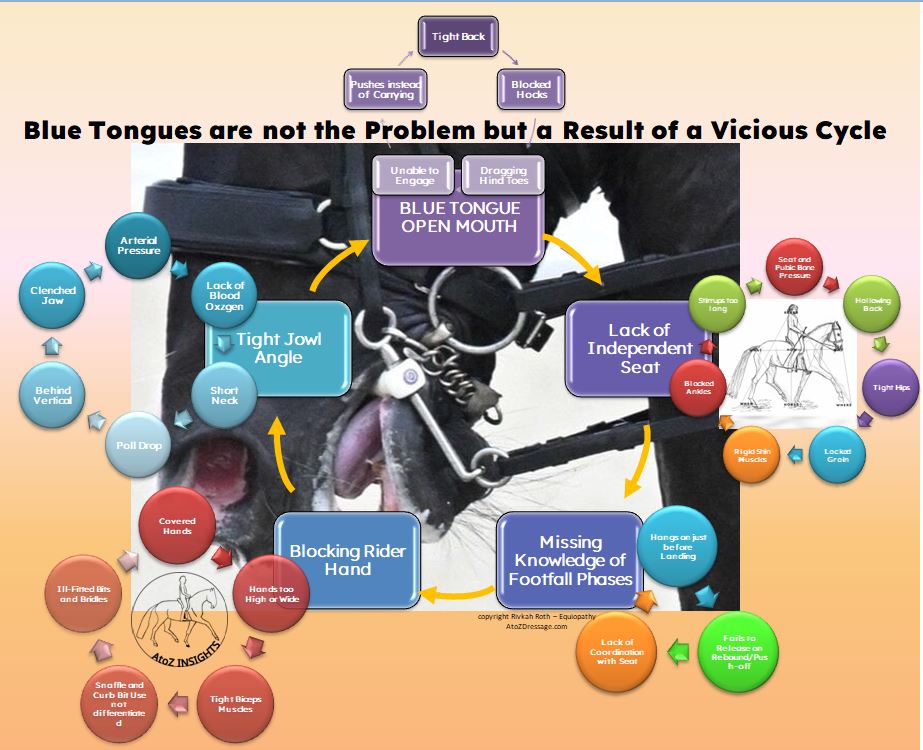
As long as the rider needs a saddle with an extremely deep seat and oversized kneeblocks, s/he is unlikely to possess the balanced spine and flexibility in sacrum, groin, hip and ankle joints to allow for a passively following pelvis.
If the light but deep seat is not naturally achieved, but by means of extremely adapted tack, it is likely that such a rider is unable to gently frame in the horse’s neck with elastically following reins (hands-wrists-elbows-shoulders). The temptation to run to contraptions and shortcuts, however unacceptable, has sadly become common even among top FEI-riders and trainers.
Lastly, the independent seat is not something we learn once and then rely on for the rest of our rider life.
We must daily, with every step or jump, carefully check up on our use of position, balance, independence, and use of our seat in conjunction with the timing of our aids.
Let’s focus more on the rider and his/her basic tools
whenever the horse does not move optimally.
There is a way to get away from these horrid blue tongues, cut and damaged tongues, lips and palates, the open mouths, and the defensive or resisting horses…
While a steward should absolutely pick up on tongue-related issues, a dressage judge is unlikely to pick up on them in the mere fraction of a second he has to glance away from the horse’s legs.
However, rider, coaches, and judges must once again become adamant in their focus on…
- open mouths,
- tight or clenched jaws,
- closed jowl angle,
- low poll (C1/atlas) vs. high C3,
- a nose temporarily or mostly behind the vertical,
- prominent underneck,
- excessive forehand sweat patterns,
- and, what nearly always occurs in conjunct with these issues, a high croup.
https://atozdressage.com/2025/01/21/focus-on-the-croup-not-the-nose/
Then the rider’s balance, position, seat, timing, and use of his aids must be corrected instead of resorting to rough riding and or gadgets.
There is a reason why we repeat the old saying:
It takes 8 years to make a horse, but 11 years to make a rider!
There is simply no shortcut for honest work. And neither money, connections, nor contraptions can replace the painstaking daily work on seat, timing and knowledge for the rider — not even an experienced GP rider.
copyright Rivkah Roth DO DNM
And, to close… allow me a word in my own cause:
If you don’t yet own my reference handbook and teaching manual, it is perhaps time for you to put in your order.
Everything that I describe here can be found in AtoZ Dressage Insights along with hundreds of other bits of wisdom. -> Link to Book Orders: https://atozdressage.com/orderbooks/
-> More Info about AtoZ Insights: https://atozdressage.com/
“A to Z Insights” is exceptional in that it combines knowledge of the Old Cavalry School of Hanover, Otto Lörke’s never written down knowledge and understanding through my first teacher, Hugo Schnapp (who, prior to fleeing from the DDR to Switzerland in 1961, was considered one of the best post-WWII dressage, 3-day event and jumper riders, trainers, and judges in East-Germany), with the knowledge I was drenched in through my grandfather and my second teacher, Hansruedi Thomi, Olympian and instructor at the Swiss Military Horse Academy (EMPfA), along with my decades of experience with biomechanics, correction riding, and teaching.
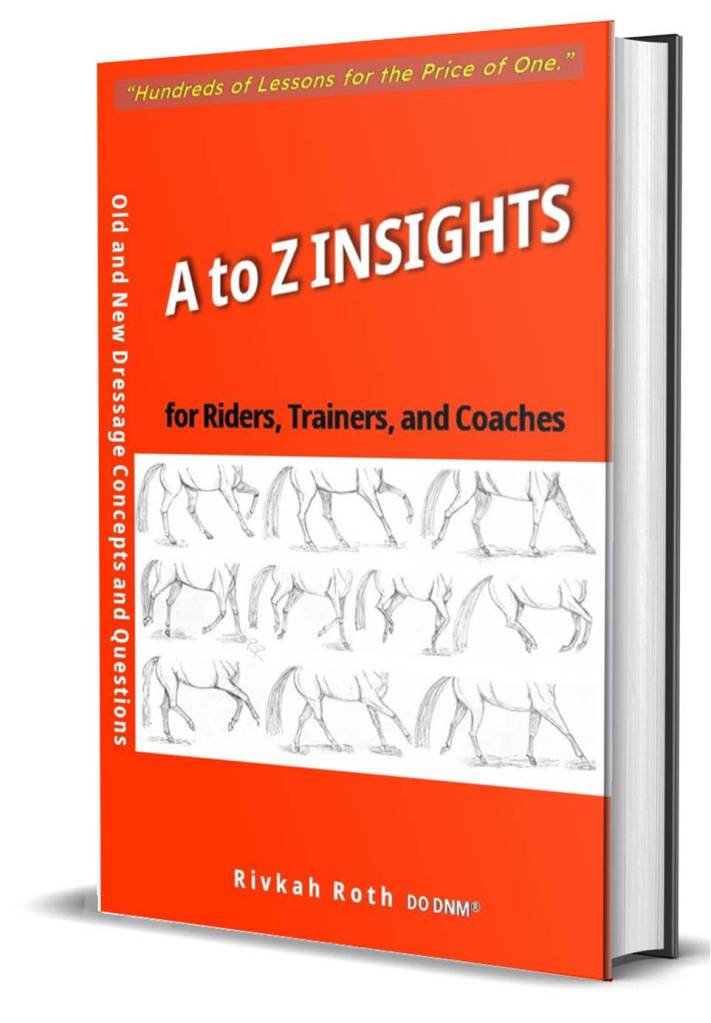
Rivkah Roth, author of the reference handbook and teaching manual, “A to Z Insights for Riders, Trainers, and Coaches — Old and New Dressage Concepts and Questions,” is the founder of Equiopathy and a natural health practitioner, lecturer and author with over six decades in the saddle as a correction rider (Swiss National License LMS since 1968) and many hours as a National Grand Prix and FEI C dressage judge.
The achievements of her former and present students and mentees include professional coaches on 5 continents (incl. CDN/EC I to III, ISR I to III, Dutch 3rd Level Instructor, USA, AUS), 1986 Dressage World Championships alternate (CDN), 1986 National GP Kuer Champion (CDN), 1992 Barcelona Olympics Long List 3-Day (CDN), 2002 Young Horse Dressage World Championships – Verden/GER (ISR), World Cup and WEG dressage horse (CDN), and countless National and Provincial Champions on all levels (CDN / ISR / SUI).
 A to Z Dressage