

lowered Croup = nose in front of the Vertical
High Croup = Nose behind the vertical
by Rivkah Roth DO DNM
Everybody understands that the nose behind the vertical shows bad riding or training.
Yet, if we understand anatomy, physiology and biomechanics, we know that…
only when the croup is lowered, can the nose come ahead of the vertical!
So, why are we fixated on the front when the rear is key?!
Correctly Lowered Croup
with equal flexion throughout all joints of the haunches:
The nose can only be on or ahead of the vertical (not behind it).
VS.
Nose behind the Vertical
The croup is always high.
The haunches can only push out the ‘back door’ past the hocks.
The horse lacks suppleness, throughness, and correct contact.
All stages of the Training Scale are missing.
but also:
Nose ahead of the Vertical without Throughness
The back is hollow.
The hind toes remain behind the stifles and drag along the ground.
In short: Everything is connected!
While the nose in front of the vertical may or may not indicate correctly working quarters, the opposite is true for the quarters.
- High quarters always pull the nose behind the vertical.
- Honestly lowered quarters always push the nose onto or in front of the vertical.
The horse that has been taught to lower its croup correctly is more likely to rhythmically…
- be on or ahead of the rider’s legs and aids.
- move uphill and in balance,
- show the kind of engagement that can result in collection of the quarters towards the CoG (centre of gravity),
- head towards self-carriage and lightness.
shift from assessing the front to judging the quarters!
Biomechanically Correct Movement always requires a croup lowered according to the horse’s age and training level. It is only attainable if the rider’s seat (see below) allows back and saddle to swing up.
In turn, only a lowered croup with hocks closer to the ground can actively catapult the body forward via an elastic rebound and push off. Such a horse carries itself forward via a lively rebound and brief ground-contact. This will result in an uphill, light movement and long suspension phases at trot and canter.
Correct movement requires…
- Quarters = active in protraction — but passive in retraction.
- Forehand = passive (light) in protraction — but active in retraction.
On the other hand, biomechanically incorrect movement results from a rider whose seat or timing of the aids block out haunches and back. This takes place in the weight-transfer and protraction phase of a footfall.
The horse then drags itself forward via overflexing foreleg joints (high knees and double flexing fetlocks). Consequently the ground-contact gets longer and the rebound or push-off phases become slower.
A wrong, high croup not only signifies lack of true collection (or a wrong front-to-back collection), it also creates…
- downhill movement,
- short or no suspension phases at trot and canter,
- a dropped poll,
- nose behind the vertical.
In short:
The horse’s front must appear as being pushed forward (out of the way) by active haunches; not the haunches being ‘schlepped’ forward by the forehand.
Eye Schooling — Passage
Compare the following three picture strips
– to allow for a fair comparison all pictures are captured in the same phase.
Left picture(s): force lines (note degree of parallelism).
Right pictures: joint angles and areas of concern e.g. hollow rider or horse back, excess fetlock drop, etc.
EXAMPLE 1 [A1 and A2 pictures]
Top international medal winner in two recent snapshots show the typical (but highly irregular) passage that we get to see today in the big FEI rings – complete with a horse’s dropped back, dragging hind toes, and a rider behind the vertical, which blocks out the quarters.
- A1: behind the rider’s legs, downhill buttock-to-mouth line together with a dropped poll (C3 vertebra as highest point), nose behind the vertical and, on close-up, some resistance in the mouth.
- A2: better on the rider’s legs, the horse comes up in the front, but still moves with a hollow back, pushing out behind, instead of carrying the weight (i.e. absence of correct collection from behind).
LEGEND:
Parallel blue respectively yellow lines = balance and clear 2-beat rhythm and suspension phases.
Loss of parallels and horse and rider joint alignment lines perpendicular to the ground = indicate lack of longitudinal throughness amid irregular rhythm, lack of lateral suppleness, and connection.
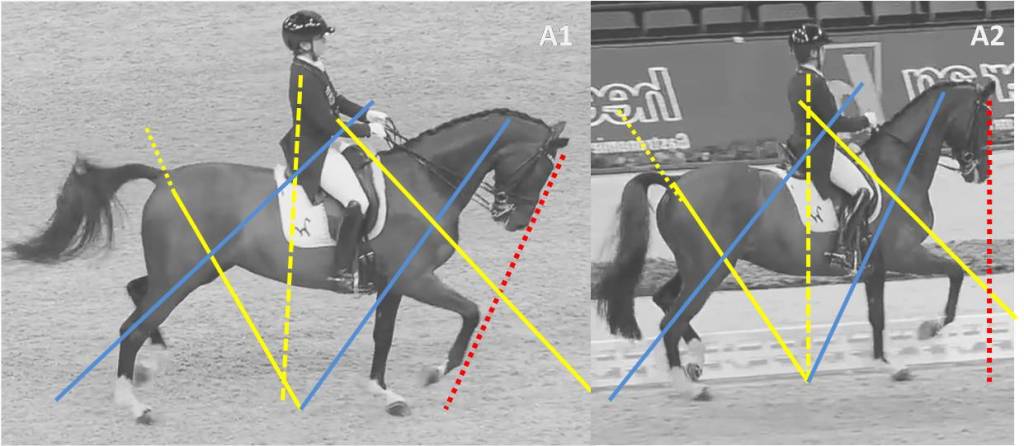
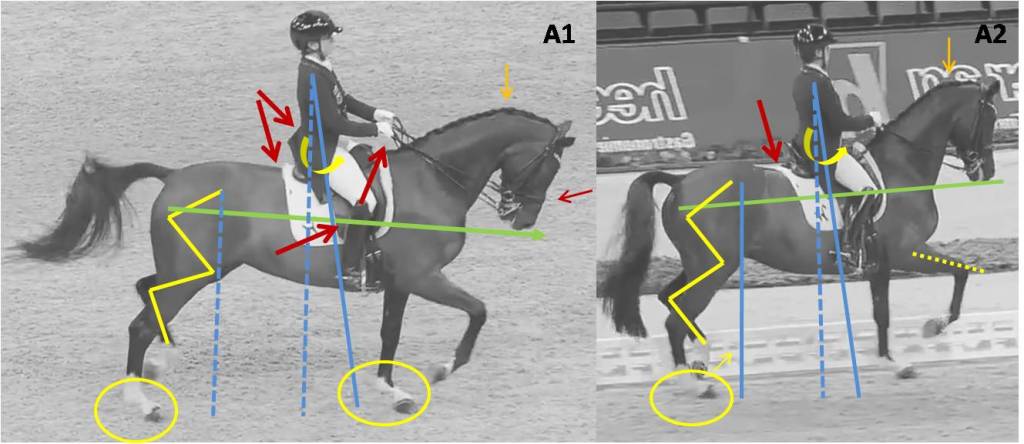
A1 and A2: The haunches push out the back instead of engaging through active and flexion of all joints of the quarters (hip – buttock – stifle – hocks – fetlocks) to exactly the same degree.
Such a movement may be flashy; but for the purpose of judging it is insufficient in every respect.
In order to coordinate rider seat and horse, we want to be 100% aware where each of the horse’s legs and joints are within each footfall and its phases, and how our seat optimizes or blocks the horse’s phases within a footfall and the relevant joints of the quarters.
Watch and study these points next time you view a video clip
(slow down the replay in “settings” to help you train your eyes to details!):
- push-off (or rebound) phase
- swing phase / suspension quality
- landing (sound and unity of diagonals)
- weight transfer (duration or brevity)
- hip joint
- buttock movement (femur head)
- stifle joint
- hock joint
- fetlock
Lack of true back-to-front Collection — in the sense of collecting the haunches underneath the joint centre of gravity — forces the horse’s barrel (back and belly) to drop through all phases from landing to weight-transfer, rebound or push-off and suspension. — Any dropping of the horse’s back closes the window to engagement and drives the croup high.
Time to start Teaching and training in a more correct manner
Note: Collection starts from the quarters.
We must get from PUSH [photo B1] to CARRY [photo B2]
Such a change always goes through the Rider’s Seat and Position!
- All joint angles of the horse’s haunches must flex identically and simultaneously — (sacrum, femur/buttock joint, stifle, hocks, fetlocks).
- One single blocked joint will force the croup up, pull down the withers, and force the horse behind the vertical.
EXAMPLE 2 [B1 and B2 pictures]
One of my present mentees. Rider and horse learning passage on the way to their first GP season (both pictures from the same session and always without ground assistance).

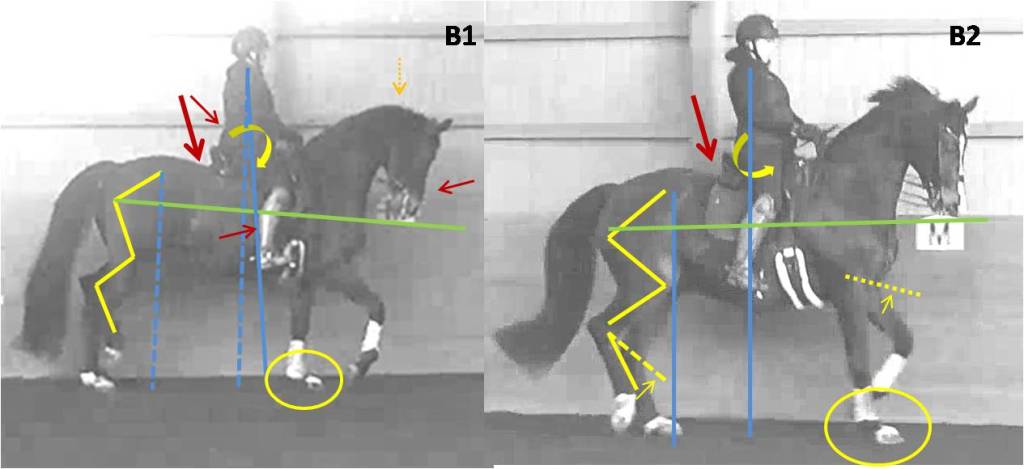
Note the improvements in balance and nose position from B1 to B2 through lowering of the croup and a better aligned seat. Back and forehand will need to raise further as additional seat work remedies hollowness. This will allow the horse yet greater lowering of haunches and croup.
Axiom of Equine Anatomy and Biomechanic Truths:
The deeper the croup can sink to the ground,
the more actively the horse’s back and withers will swing up,
and the more the nose comes ahead of the vertical.
And lastly, EXAMPLE 3 [C picture]
For the purpose of making a point and gaining a few pictures:
For the first time in 22yrs with permanently disabling injuries, I once again climbed in the saddle to demonstrate how to playfully teach balance, collection, piaffe and passage to an older horse without help of a ground person:
=> Strictly with meticulous seat alignment and precision of lumbar tuck (active back to front support), pelvic tilt (passively following through the movement phases), and precisely timed aids.
PS I always ride with the classical 3:1 double bridle rein arrangement
making meticulous use of the different receiving actions of bradoon vs. curb bits.


Shows promising balance and engagement angles, uphill while not fully free in the shoulder yet,
but already light in contact and bridle, clearly in front of the rider’s aids in starting self-carriage.
The respective mark-ups and lines on this picture demonstrate that it would still be possible in 2024 to ride in the classical cavalry school tradition as taught to me by Hugo Schnapp (an Otto Lörke colleague), and my EMPfA instructor, Hansruedi Thomi in the 1960s.
To repeat:
An actively and correctly lowered croup brings the hocks closer to the ground, and will always result in a nose on or ahead of the vertical.
The Problem is the Seat of the Rider, not the Horse!
Only the rider in self-carriage can expect self-carriage in his/her horse!
Riders need to work on their self-carriage not only in the passage, but also in every stage from the green remount to the GP horse.
For the rider this means allowing the saddle to come up into the rider’s seat, i.e. …
- no hollowing of the rider back with a downwards tipping pelvis in the front,
- no pushing down or blocking with seat bones or pubic area,
- no stepping down heavily in the stirrups,
- no stretching forward of the lower rider legs out of rigid hip joints,
- no pulling up and steering with high and wide hands.
A rider with a hollow back (more common in female riders) will a l w a y s block out the quarters and ride a horse downhill. Such a blocking action is likely to cause damage in the horse’s hocks and stifles, lumbar and thoracic spine, lower neck, atlas (head connection) and jaw.
Moreover, a rider’s internal alignment behind (or ahead) of the balls of his feet (trampoline-like use of the stirrup bars) always makes the horse heavy in the bridle.
Note: In an elastic contact, good riding has no more than 5 to 50 grams of weight in a rein!
Riders who pull up their knees and push forward their lower legs cause a false elevation of the horse’s front (dropped withers, shortened neck, pulling rider hands). This will always interrupt the lateral swing and longitudinal throughness of the horse’s back. — Many horses ridden in this manner flail their legs like carriage horses that hold their backs still between the traces of their cart.
Longitudinal (rhythm) and lateral (swing, relaxation) throughness can only come from the quarters.
Again: all of this requires the lowering of the croup and the activation of the haunches. This must never be attempted via whip-lashing with in-hand-work or an assistant on the ground, but through a meticulously, and softly following rider seat (passive pelvic tilt) and a deep understanding of timing!
Remember:
- The dressage seat is a balance seat!
- A deep seat is always a light and elastically following seat (horizontal not vertical plane)!
- No plunking of our backside into the saddle and letting the horse carry our weight!
- No water-skiing seat with leaning back trunk and pushed forward legs!
- No hanging on with biceps on wide and high carried hands!
The rider must learn to balance his/her seat elastically over the balls of the feet, not the heels.
Only with this weight distribution (along a line perpendicular to the ground) can the rider’s knees and ankles ‘let go’ and elastically absorb the action of the horse’s hind fetlocks through landing, weight-transfer, rebound, push-off, and suspension phase.
Often neglected: For a horse that truly ‘sits,’ the rider may have to actively bring her sternum forward into the protraction motion as not to end up hollow-backed or “water-skiing” on horseback [see seat problem in A1) and B1) pictures above.] — This necessary correction is missed by many of the top riders and coaches. Without it we end up riding the croup high and the quarters “out the backdoor.”
Once the rider can maintain her spinal balance while following the movement of the horse’s back with her seat muscles, the horse’s movement can be optimized and the musculoskeletal (and mental) stress on the horse be minimized.
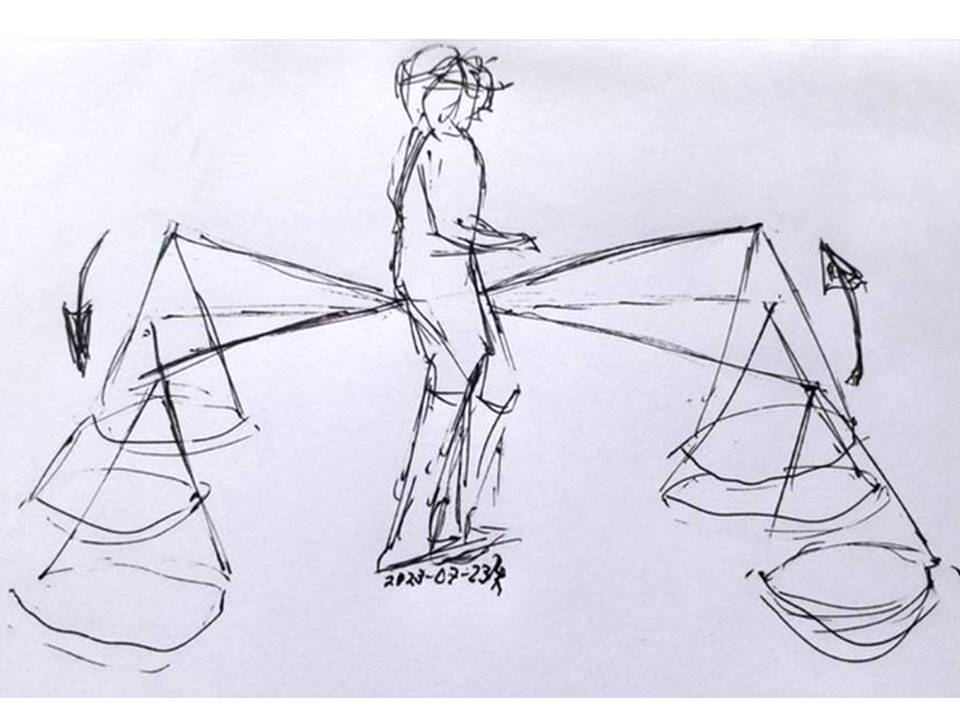
- The rider’s job is not to be carried by the horse.
- It is the rider’s obligation to realign herself as a neutral pivot that allows for optimal self-carriage of horse and rider.
- Only a rider whose balance remains perpendicular to the ground can attempt to precisely shift the horse’s centre of gravity (CoG).
- To appear with a still spine, requires constant and controlled movement of sacrum, hip joints (groin), yo-yo knees (shin muscles), instep/ankle (toes up).
In short, if we want the croup to drop, it requires an educated seat and a proper understanding of Collection.
Collection is always…
- a gathering up of the quarters from behind under the CoG. — (Only possible with the important perpendicular rider seat alignment line with elastic hip/groin, knee and ankle joints along the vertical plane).
- a forward engagement of the haunches under a back and belly of the horse that must be able to swing up into the rider’s seat and saddle. — (Needs an elastically following rider pelvis, yet with a positive lumbar tuck along the horizontal plane.)
Admonishment to our Dressage Judges,
the international and National Federations (FEI and FN),
Riders, Trainers and Coaches:
Change how we judge dressage
and the riders will change how they train!
First, always look at…
1) the croup: is it lowered or high?
2) the active angles of the hindlegs: are they all equally active or are one or several joints blocked?
Then give your mark according to what you see take place in the quarters.
Such marks will always be correct.
Moreover these marks will directly reflect mouth, neck, forehand problems, as well as rhythm, suppleness, throughness and responsiveness to the rider’s aids!
What looks like guess work taking place in those judges booths of today, in reality (with diligent eye schooling) can be brought once again to “real values” and a well-founded marking approach.
Unlike marks gained by watching the front of the horse, marks gained by the action of the quarters can then be argued and backed up by a meticulous assessment of the…
- height and level of the horse’s croup,
- angles of all hindleg joints,
- hoof placement with regards to the extension of the iliac crest – stifle plumb line.
In Summary:
Stop looking at the Nose!
Look at the Croup and the Joint Angles of the Haunches!
And a final word: There simply are no shortcuts to lowering the croup!
The rider needs to school herself until she achieves…
- an impeccable position, and independent seat and hands,
- the feel for each single phase of the footfalls,
- a thorough understanding of the application and timing of the aids.
Only then we can bring the horse along, step by step through the stages of the widely acknowledged and proven Training Scale of non-negotiable…
- Rhythm (a longitudinal component),
- Suppleness (the lateral component),
- Contact (established by the horse, not the rider),
- Impulsion (into an elastic rider seat),
- Straightness (along with proper longitudinal bend through corners and on bent lines),
- Collection (longitudinal back-to-front component).
Let’s contribute to a guaranteed future for the horses in our life. To consistently work on the rider’s seat and ability to properly use his/her aids, is the most horse-centric and proactive approach we can take.
Also see these earlier blog posts of mine on these issues:
https://atozdressage.com/2024/07/17/the-failure-of-dressage-judging/
https://atozdressage.com/2024/04/21/eye-schooling/
https://atozdressage.com/2023/10/04/unfortunate-developments-in-dressage/
https://atozdressage.com/2023/10/03/training-knows-no-shortcuts/
copyright Rivkah Roth DO DNM
And, to close… allow me a word in my own cause:
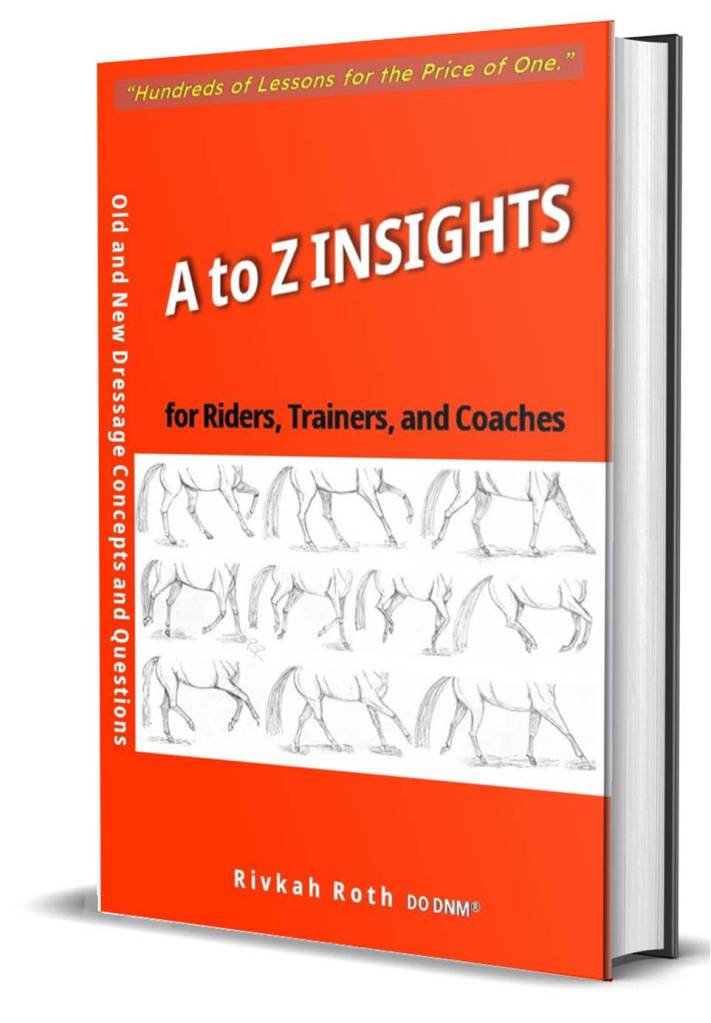
If you don’t yet own my reference handbook and teaching manual, it is perhaps time for you to put in your order.
Everything that I describe here can be found in AtoZ Dressage Insights along with hundreds of other bits of wisdom. -> Link to Book Orders: https://atozdressage.com/orderbooks/
-> More Info about AtoZ Insights: https://atozdressage.com/
“A to Z Insights” is exceptional in that it combines knowledge of the Old Cavalry School of Hanover, Otto Lörke’s never written down knowledge and understanding through my first teacher, Hugo Schnapp (who, prior to fleeing from the DDR to Switzerland in 1961, was considered one of the best post-WWII dressage, 3-day event and jumper riders, trainers, and judges in East-Germany), with the knowledge I was drenched in through my grandfather and my second teacher, Hansruedi Thomi, Olympian and instructor at the Swiss Military Horse Academy (EMPfA), and my decades of experience with biomechanics, correction riding, and teaching.
Rivkah Roth, author of the reference handbook and teaching manual, “A to Z Insights for Riders, Trainers, and Coaches — Old and New Dressage Concepts and Questions,” is the founder of Equiopathy and a natural health practitioner, lecturer and author with over six decades in the saddle as a correction rider (Swiss National License LMS since 1968) and many hours as a National Grand Prix and FEI C dressage judge.
The achievements of her former and present students and mentees include professional coaches on 5 continents (incl. CDN/EC I to III, ISR I to III, Dutch 3rd Level Instructor, USA, AUS), 1986 Dressage World Championships alternate (CDN), 1986 National GP Kuer Champion (CDN), 1992 Barcelona Olympics Long List 3-Day (CDN), 2002 Young Horse Dressage World Championships – Verden/GER (ISR), World Cup and WEG dressage horse (CDN), many National and Provincial Champions on all levels (CDN / ISR / SUI).
 A to Z Dressage