

and how it may detrimentally influence today’s
riding Style and training approaches.
by Rivkah Roth DO DNM
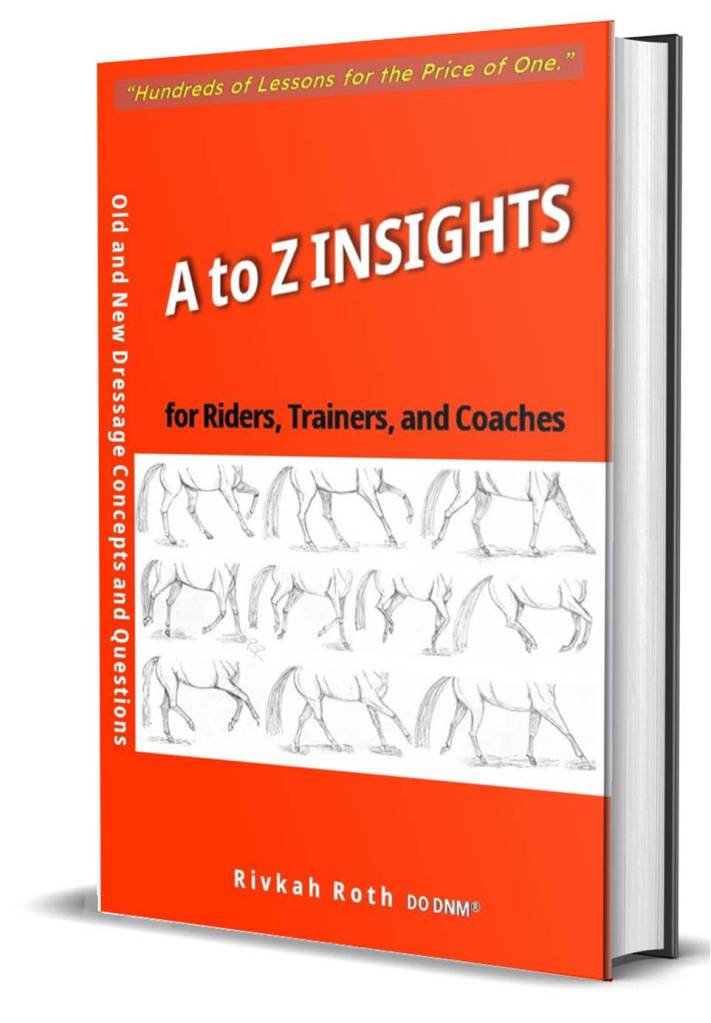
I have long said it, including postulating better eye schooling for the dressage judges and tips on how to get to a more correct eye in my reference handbook and teaching manual “A to Z Insights for Riders, Trainers, and Coaches – old and new dressage concepts and questions” .
It matters HOW we judge, not solely WHAT we judge!
While the FEI guide lines spell out rather correctly the requirements of each Dressage movement as well as the overall appearance and use of body of a dressage horse, it does not emphasize or explain how these results are achieved.
Neither does the general dressage judges’ education, training and practice teach how and where to look before coming up with a defining mark.
This diligently researched article, recently published in animals, spells out the underlying issue with today’s judging:
In the Eye of the Beholder—Visual Search Behavior in Equestrian Dressage Judges by Inga Wolframm, Peter Reuter, Iulia Zaharia and Johannes Vernooij.
file:///C:/Users/ndocr/Downloads/animals-14-02025-v2-1.pdf
Eye-tracking was used to find out duration and focus of visual gaze patterns of a group of twenty judges from different levels while judging Grand Prix dressage tests. Findings showed that nearly all (!) judges paid more attention to the front of the horse, with the more advanced judges focusing more on the horses’ feet and the less schooled judges at the horse’s rider.
It appears that judges indeed don’t know how to look (and see), and thus fail to understand that, by looking at the front of the horse, we cannot make any accurate assumptions on the workings of the horse’s contact, withers, back, quarters, and haunches.
However, by learning to accurately look at and interpret the movement phases of the horse’s quarters (croup, haunches, fetlocks, and toes) we can indeed accurately predict what is going on in the horse’s back and front.
Such an entirely different approach to judging — i.e. if the FEI would demand that “the judges primarily focus on croup and haunches” — would benefit the welfare of the horses. Training shortcuts and roughshod methods, as well as rider short comings would be brutally unveiled.
A spontaneous, but rarely accurately verifiable “like” factor among the judges will then be replaced with technical knowledge and understanding of the biomechanical movement laws of the equine body in relation to its conformation and training.
As a result, additional and highly specific eye schooling could lead to a more transparent judging process with greater unanimity among the judges.
For the horse on the other hand such a judging approach will result in more systematic and diligent schooling according to the classically accepted training scale. It should also result in fewer episodes of resistance and renegade behaviour as we so often witness in the arena by short-cut schooled and simply not confident horses.
For the spectator this will – hopefully soon – reflect itself in fewer negative pictures of high croups, irregular movement, tight jowl angles with dropped polls, and horses behind the vertical and behind the riders’ aids.
You may also want to read my earlier blog post from April 21, 2024 on the topic of Eye Schooling https://atozdressage.com/2024/04/21/eye-schooling/
And, to close… a word in my own cause:
If you don’t yet own my reference handbook and teaching manual, it is perhaps time for you to put in your order.
Everything that I describe here can be found in AtoZ Dressage Insights along with thousands of other bits of wisdom. -> Link to Book Orders: https://atozdressage.com/orderbooks/
-> More Info about AtoZ Insights: https://atozdressage.com/
This book is exceptional in that it combines knowledge of the Old Cavalry School of Hanover, Otto Lörke’s never written down knowledge and understanding through my first teacher Hugo Schnapp who, prior to fleeing from the DDR to Switzerland in 1961, was one of the best post-WWII dressage and 3-day event riders, trainers, and judges in East-Germany, with the knowledge I was drenched in through my grandfather and my second teacher, Hansruedi Thomi, Olympian and instructor at the Swiss Military Horse Academy (EMPfA).
copyright Rivkah Roth DO DNM
Rivkah Roth, author of the reference handbook and teaching manual, “A to Z Insights for Riders, Trainers, and Coaches — Old and New Dressage Concepts and Questions,” is the founder of Equiopathy and a natural health practitioner, lecturer and author with over six decades in the saddle as a correction rider (Swiss National License LMS since 1968) and many hours as a National Grand Prix and FEI C dressage judge.
The achievements of her former and present students and mentees include professional coaches on 5 continents (incl. CDN/EC I to III, ISR I to III, Dutch 3rd Level Instructor, USA, AUS), 1986 Dressage World Championships alternate (CDN), 1986 National GP Kuer Champion (CDN), 1992 Barcelona Olympics Long List 3-Day (CDN), 2002 Young Horse Dressage World Championships – Verden/GER (ISR), World Cup and WEG dressage horse (CDN), many National and Provincial Champions on all levels (CDN / ISR / SUI).
 A to Z Dressage