
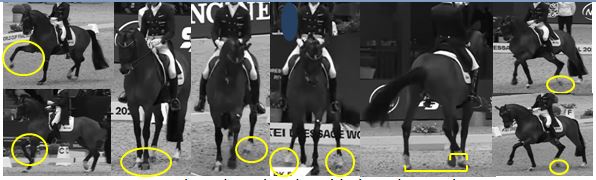
The dressage world is waking up
by Rivkah Roth DO DNM
A new generation of riders is looking to get trained along the classical criteria of systematic horse training as described by the Training Scale (Ausbildungsskala).
Meanwhile, many of the international top riders still subscribe to shortcuts – possibly encouraged by dressage judges who fail to penalize or maybe fail to recognize training errors and issues.
Schooling the Eye can and must be Learned!
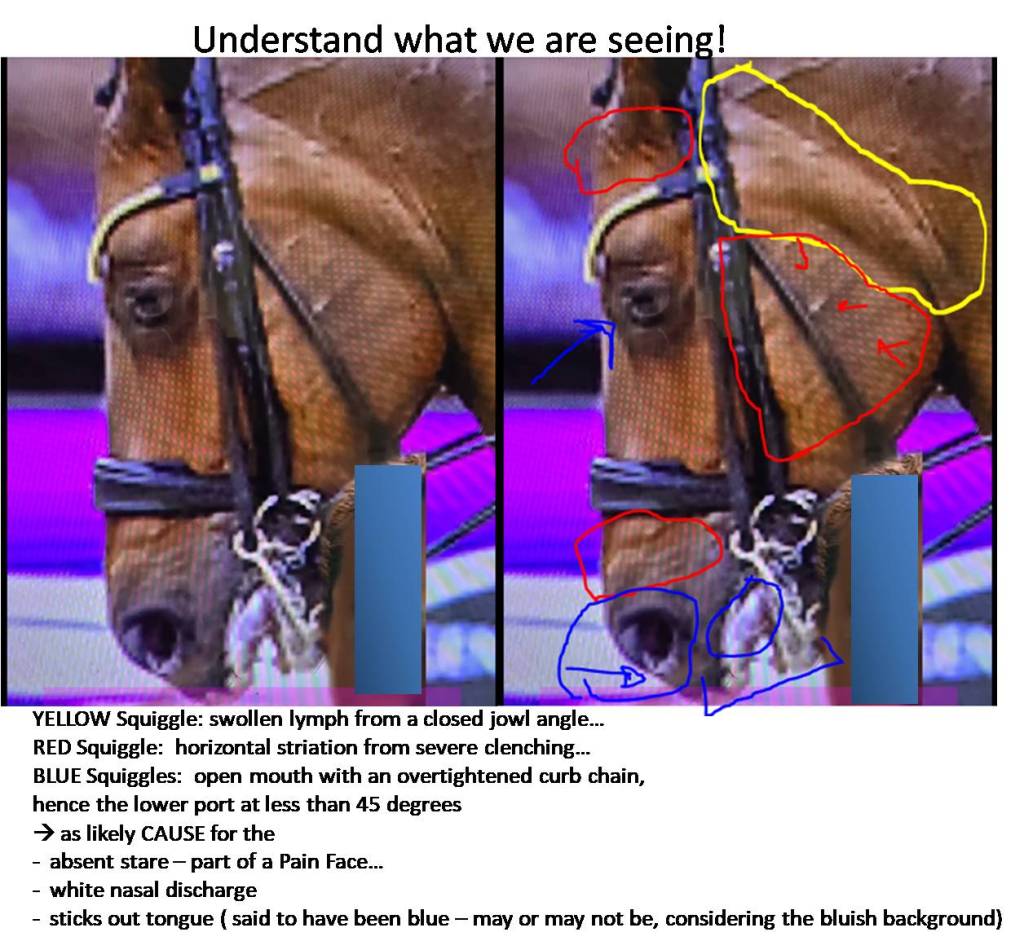
What do we see?
This picture (left) as part of a critical 3rd party post about a “blue tongue” is making the rounds…
…Having seen how much playing with photo colours can influence the colour of a tongue, I am not going there.
However, since the tongue is but a symptom of underlying issues, I don’t even need to talk about tongue colour.
There are plenty of Other Issues to tell the Story:
The areas I highlighted in the second picture leave no doubt of a horse…
– not worked classically correct,
– not being through,
– supple,
– “straight” and
– well balanced.
In Short…
the above picture shows a horse in incorrect contact with tongue, mouth, jaw, and poll problems.
“Moment in Time,” you say…
After well over half a century as a correction rider and trainer of horses and riders, dressage judge, and biomechanics expert, I simply need to list the signs and symptoms and ask two questions:
“Can these signs develop over a single step?”
“Do these signs make sense with regards to the laws of biomechanics and anatomy?”
- The white froth coming out of the nostrils is not happening in a split second!
- Neither is the curb shank (tightened to less than 30 degrees) there just for a single step. — And to those who say, that this is simply a looser curb I say NO (the open mouth contradicts such a claim beyond doubt!). — And, by the way, also compare below the different curb shank angles in the uneven foreleg lift pictures (among the rider attempting to lift the LF with his ipsilateral hand)!
- Neither will the horizontal striping of cheek muscles, below the ears, and the area above the nostrils become this prominent under solely temporary pressure for a couple of steps.
- Neither do the lymph glands (jowl angle and above the eye) swell to this extent if a horse is not constantly ridden in too narrow a frame and a closed jowl angle.
“It’s just the Head – the Rest of the Horse moves fine,” you say…
Because of the interlacing muscle chains of the horse that connect the mouth to the poll and the poll via the C7 (cervical-thoracic) pivot to the sacrum and the horse’s hind fetlocks, a clenched jaw such as in the above picture will be associated with most of the following movement “irregularities”…
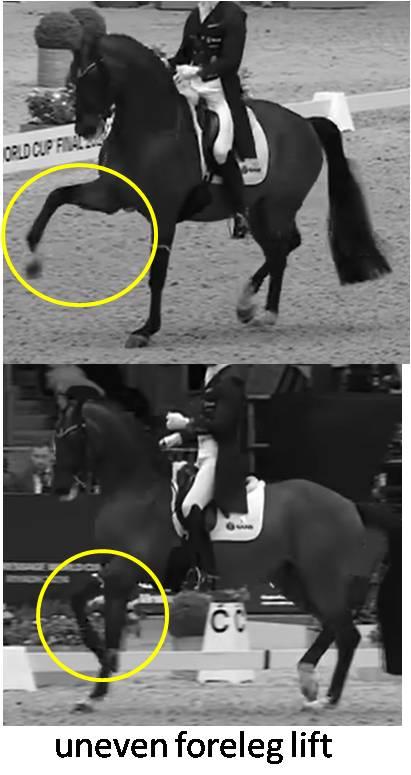

- Uneven foreleg lift (case in point – watch the video!) e.g. one leg moves up then opens, while the other moves forward then up.
- Crossing-in or narrowing of the foreleg track.
- Widening of the hindlegs, or occasional (or regular) stepping out with one or both hindlegs – usually most obvious through the 3Ps (Piaffe, Passage, Pirouette).
Apart from resulting in the above mentioned facial signs, all of these movement issues point to spinal instability in the area right behind the scapula/withers (tight gullet plate? too tight a girth? gripping rider legs? etc.) in what we used to call a “disconnected horse.”
Granted, it initially may require patience, practice, and many replays, slow motion or stops to learn to spot and observe differences. — Not everyone is as lucky as I was as a 2-yr old with my grandfather pestering me already with footfall, landing moment, and overtrack distance questions.
It will help to know what to look for.
Perhaps much easier to spot than some of the above listed issues is the dragging of one or both hind toes.
The process and predictability of a single hind foot dragging can be described as follows (same problem described in two different ways):
- Dragging hind toes most commonly show on the same side (ipsilateral) as the excessively raised foreleg (e.g. the RH).
Or we can describe it this way:
- Dragging hind toes most commonly show on the opposite side (contralateral) of the more restricted foreleg – the diagonal RH-LF.
Hind toe drag as a manner of movement (e.g more than 2 steps/strides in a row) also point to issue with longitudinal “Straightness” (i.e. unstable spine, different degrees of “Longitudinal Bend” on left vs. right rein).

So, why do today’s judges not see this?
…or do they indeed gullibly decide to ignore these signs of a front-to-back schooled or hand-ridden horse?
Isn’t it time for the FEI to integrate (as it used to in its very beginnings) experienced, classically working trainers as outside consultant, supervisor, or instructor to the team responsible for the training of the judges, instead of the present process of any older FEI judges training the younger ones? – [Probably worth another blog post soon…]
Too many riders today neglect their own ongoing training or have not learned all the old wisdoms that already addressed exactly these issues at the turn from the 19th to the 20th century (z.B. Gustav Steinbrecht – Gymnasium of the Horse), and again between about 1948 and 1957 (post 1956 Stockholm Olympics and post-WWII) when many of the best horse trainers and riding teachers were lost for ever to the equestrian community.
I decided to share this solely as an eye opener and teaching opportunity, with the hopes that we all become more critical (of our own work too). After all, there is a reason for the old saying that…
It takes 8 years to make a horse
and 11 years to make a rider.
And, to close… a word in my own cause:
If you don’t yet own my reference handbook and teaching manual, it is perhaps time for you to put in your order.
Everything that I describe here can be found in AtoZ Dressage Insights along with thousands of other bits of wisdom. -> Link to Book Orders: https://atozdressage.com/orderbooks/
-> More Info about AtoZ Insights: https://atozdressage.com/
This book is exceptional in that it combines knowledge of the Old Cavalry School of Hanover, Otto Lörke’s never written down knowledge and understanding through my first teacher Hugo Schnapp who, prior to fleeing to Switzerland in 1961, was one of the best post-WWII dressage and 3-day event riders, trainers, and judges in East-Germany with the knowledge I was drenched in through my grandfather and my second teacher, Hansruedi Thomi, Olympian from the Swiss Military Horse Academy (EMPfA).
We owe it to all horses to make their life with us easy, fun, and resulting in long lasting soundness!
copyright Rivkah Roth DO DNM
Rivkah Roth, author of the reference handbook and teaching manual, “A to Z Insights for Riders, Trainers, and Coaches — Old and New Dressage Concepts and Questions,” is the founder of Equiopathy and a natural health practitioner, lecturer and author with over six decades in the saddle as a correction rider (Swiss National License LMS since 1968) and many hours as a National Grand Prix and FEI C dressage judge.
The achievements of her former and present students and mentees include professional coaches on 5 continents (incl. CDN/EC I to III, ISR I to III, Dutch 3rd Level Instructor, USA, AUS), 1986 Dressage World Championships alternate (CDN), 1986 National GP Kuer Champion (CDN), 1992 Barcelona Olympics Long List 3-Day (CDN), 2002 Young Horse Dressage World Championships – Verden/GER (ISR), World Cup and WEG dressage horse (CDN), many National and Provincial Champions on all levels (CDN / ISR / SUI).
 A to Z Dressage