
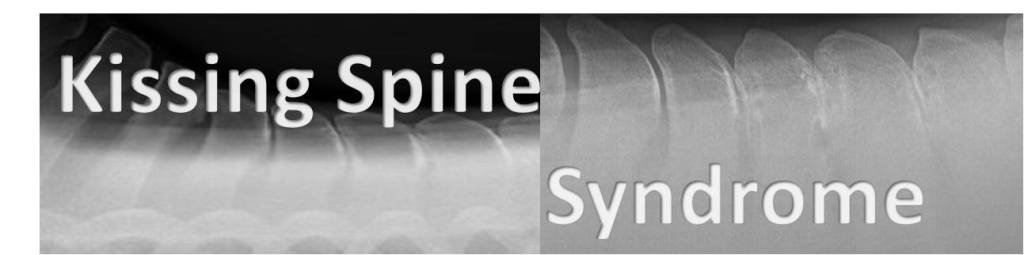
Back and Neck Health Co-determine Suppleness or Resistance
by Rivkah Roth DO DNM
Does your horse show signs of resistance or evasive behavior? Even more so, has such behavior started after a change in its training routine, farrier work, saddle or rider?
Signs that your horse has become reactive…
- Can’t stand in a relaxed manner on all fours during grooming and picking of hooves;
- Shows aggravated restlessness once saddled;
- Drops or stretches its back on mounting;
- Moves off in a rigid manner;
- Hesitates to move forward, bucks, or runs in short steps
- Resists bending especially to one side;
- Braces itself against longitudinal bending through corners and circles;
- Resists stepping under its center of gravity (engaging);
- Lacks or resists suspension and ground-cover;
- Difficulties in picking up canter in one or both directions.
Think about an issue within the spine and its processes.
For Comparison – the Rider
Every rider has experienced a sore back or neck at some time or another.
Here just a few examples:
- Being unable to fully raise one arm due to wry neck (torticollis) or a blocked first rib is not only painful but can play havoc with our mind and its ability to focus.
- Sacroiliac pain, a pinched diaphragm, or worse, a hollow back with a pelvis that drops down in the front will often stop us from moving up and down stairs freely.
We then catch ourselves holding our breath, turning mostly to one side, learning to compensate and, most obviously, taking one long and one short step, or even dragging one leg.
Even though these are just these few examples, they completely mirror what may be going on in our horse’s spine.
The Horse – Hidden and Obvious Causes
Due to their largely horizontal position, back and neck issues are wreaking havoc for the horse as much as for us humans – if not more.
Especially if the horse finds itself saddled (pun intended) with an ill-fitting saddle and a rigid or a floppy rider, who lacks body-control to follow the horse’s back longitudinally and laterally without letting her center of gravity flop all over the place, it is no surprise that the horse starts to show resistance.
However, we now already see back and neck issues in some young not yet mounted horses. This may come unexpected, but may point to a couple of additional predisposing factors:
- fewer unrestrained opportunities for free movement for the youngsters (and for older horses) at trot, canter and gallop. The back and neck musculature thus lack natural strengthening through an elastically up and down moving spine in cooperation with actively engaging haunches.
- new training fads or subduing horses with on the spot and slow motion hand- or ground-work.
- a recent (in my opinion biomechanically plain wrong) farrier approach towards lower heel trims on the hindlegs than on the fore. This nearly always leads to prolonged, yet undesirable, ground contact and weight transfer, reduced suspension phases and shortened ground cover.
Prior to the 1980s we bought horses on flexion tests. Not much later, leg X-rays became the norm. What I have noticed in the past decade or so is that even youngsters these days may show early spinal issues that call for a full set of back and neck X-rays already in many a 3 yr. old even before being mounted.
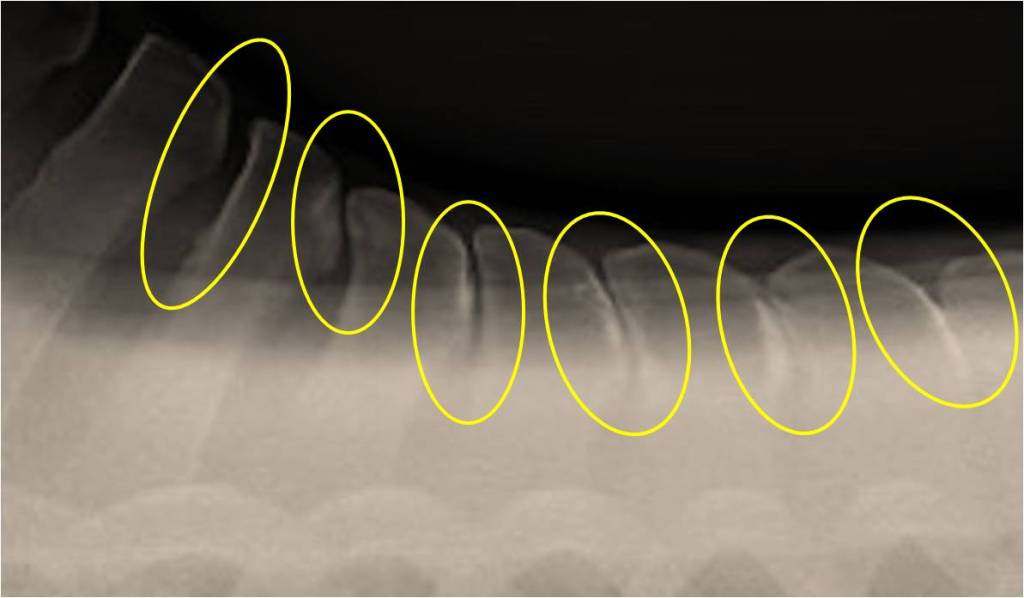
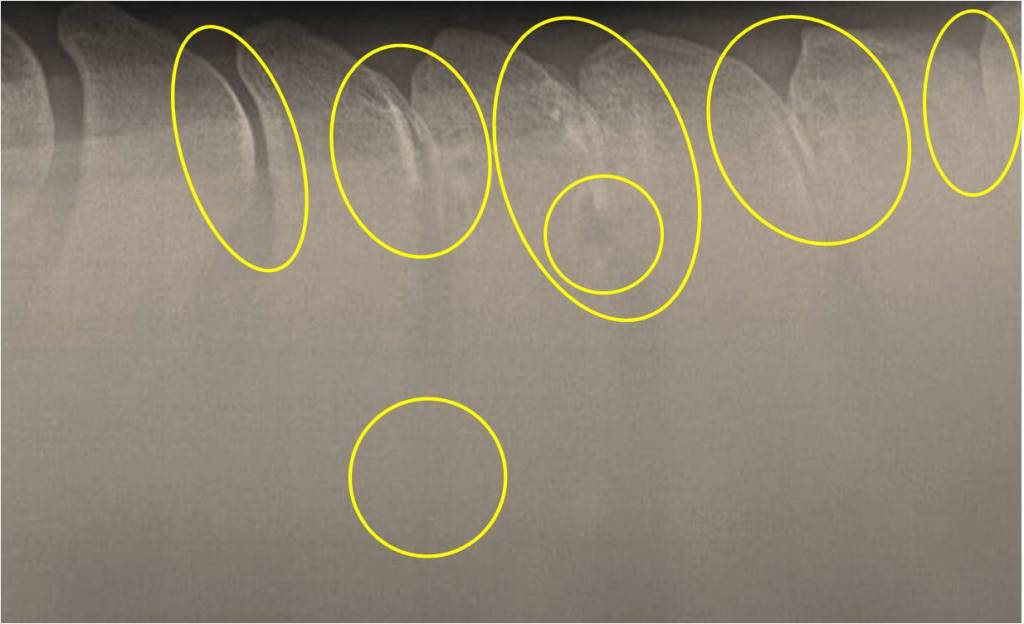
However, X-ray pictures such as the above samples generally are more common in ridden horses. And, sadly, perhaps at least a partial result of paying less attention to rider education and seat.
It is perhaps for this reason that, over the years, I have seen way more horses with dropped backs and upside down muscled necks for Equiopathy assessments and treatments out of amateur hands and by some short-cut ‘trainers’ than horses handled by true professionals. The latter tend to patiently work with their horses according the principles of the classical Training Scale as described in https://atozdressage.com/ and produce horses that remain sound for a long time.
The Moral Of The Story
Whenever the level of cooperation of your horse goes down, or you run into any of the above mentioned issues…
- Get your veterinarian to run a set of neck and back X-rays of your horse. It will shorten your trouble-shooting process.
- Get a knowledgeable second opinion on reading the X-rays before deciding on a remedial approach.
It is all too easy to miss contributors such as farrier work, saddle fit and, most of all, rider issues.
copyright Rivkah Roth DO DNM
Rivkah Roth, author of the reference handbook and teaching manual, “A to Z Insights for Riders, Trainers, and Coaches — Old and New Dressage Concepts and Questions,” is the founder of Equiopathy and a natural health practitioner, lecturer and author with over six decades in the saddle as a correction rider (Swiss National License LMS since 1968) and many hours as a National Grand Prix and FEI C dressage judge.
The achievements of her former and present students and mentees include professional coaches on 5 continents (incl. CDN/EC I to III, ISR I to III, Dutch 3rd Level Instructor, USA, AUS), 1986 Dressage World Championships alternate (CDN), 1986 National GP Kuer Champion (CDN), 1992 Barcelona Olympics Longlist 3-Day (CDN), 2002 Young Horse Dressage World Championships – Verden/GER (ISR), World Cup and WEG dressage horse (CDN), many National and Provincial Champions on all levels (CDN / ISR / SUI).
 A to Z Dressage